Company Training: How to Build Skills, Improve Performance, and Prove ROI
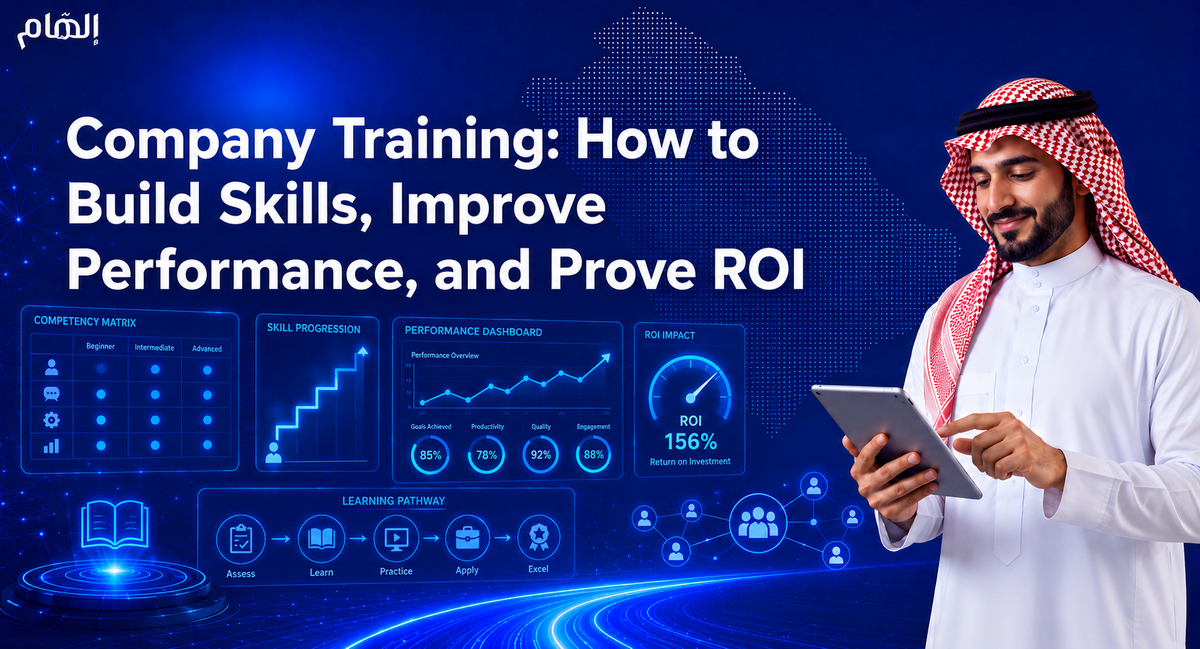
Company training is no longer simply about organizing courses, tracking attendance, or asking employees to complete another online module.
Today, Learning and Development teams are expected to solve much bigger problems.
They must prepare employees for changing roles, close critical skills gaps, support digital transformation, develop future leaders, and prove that learning contributes to business performance.
That is what effective company training should accomplish.
A successful training strategy connects four elements:
- The company’s goals.
- The capabilities employees need.
- The learning experiences that build those capabilities.
- The performance results that demonstrate impact.
In this guide, we will explore everything L&D professionals need to know about company training from identifying learning needs and choosing training methods to measuring behavioral change and calculating return on investment.
What is company training?
Company training, also known as corporate training or workplace training, is the structured process of helping employees acquire the knowledge, skills, and behaviors they need to perform effectively.
It can prepare employees for their current responsibilities, help them adapt to changing requirements, or qualify them for future roles. Company training may include:
- New-employee onboarding.
- Technical and functional training.
- Compliance and safety programs.
- Leadership development.
- Sales and customer-service training.
- Digital and AI upskilling.
- Human and interpersonal skills.
- Career-development programs.
- Succession and high-potential development.
- Product training for employees, customers, or partners.
But here is an important distinction: training is not the same as learning and development.
Training vs. learning vs. development
Although these terms are often used interchangeably, they have different purposes.
The difference matters because an organization may request “training” when the actual need is coaching, better tools, clearer processes, or a complete development pathway.
Why is company training important?
The business case for company training has become stronger as jobs, technologies, and skills continue to change.
The World Economic Forum estimates that 22% of today’s jobs will experience disruption by 2030. It also reports that 85% of employers plan to prioritize workforce upskilling, while skills gaps remain one of the main barriers to organizational transformation.
This means organizations cannot depend entirely on hiring new talent whenever their needs change. They must also develop the people they already have.
An effective company training strategy can help an organization:
- Close current and future skills gaps.
- Improve employee productivity.
- Reduce operational errors.
- Accelerate new-hire proficiency.
- Improve product and service quality.
- Strengthen compliance.
- Reduce safety and cybersecurity risks.
- Support technology adoption.
- Prepare future leaders.
- Build succession pipelines.
- Preserve institutional knowledge.
- Improve internal mobility.
- Increase employee engagement and retention.
LinkedIn’s 2025 Workplace Learning Report found that 49% of L&D and talent professionals feel pressure from a skills crisis. The report also suggests that organizations connecting learning with career development are better positioned to attract, develop, and retain talent.
However, these benefits do not come from offering more courses. They come from building the right capabilities and ensuring that employees apply them in their work.
What are the main types of company training?
The right training portfolio depends on the organization’s industry, workforce, strategy, and risks. Most companies need a combination of these training types.
How to build an effective company training strategy
An effective training strategy begins with business priorities and follows these four steps.
Step 1: Identify the business goal
Step 2: Diagnose the performance problem
Step 3: Conduct a training needs analysis
Step 4: Prioritize training needs
How to define competencies and proficiency levels
A competency describes the knowledge, skills, behaviors, and attributes required for effective performance. A useful competency framework should include:
- A clear competency name.
- A practical definition.
- Observable behaviors.
- Relevant roles.
- Required proficiency by role.
- Assessment methods.
- Development opportunities.
Organizations can use a five-level proficiency model:
The framework should describe what performance looks like in the actual workplace. Competencies written in vague HR language will be difficult to assess or use.
It should also remain flexible. Roles, tools, and strategic priorities change, so competency frameworks require regular review.
How to write measurable learning objectives
A learning objective defines what employees should be able to do after completing the learning experience. Consider these two examples.
Weak objective:
Employees will understand customer service.
Measurabe objective:
By the end of the program, customer-service representatives will be able to classify a customer complaint, select the appropriate resolution process, and document the case accurately in the CRM.
Strong objectives specify:
- Who will perform the action.
- What they will do.
- Under what conditions.
- To what standard.
Also make sure to use observable verbs. Words such as “know,” “learn,” and “understand” are difficult to measure. Verbs like:
- Identify.
- Demonstrate.
- Apply.
- Diagnose.
- Compare.
- Evaluate.
- Design.
- Resolve.
- Prioritize.
- Create.
How to design an effective training program
One of the best ways to design corporate training is to work backward from the desired result. The process looks like this:
- Define the business result.
- Identify the workplace behaviors affecting that result.
- Determine the required skills and knowledge.
- Decide what evidence will demonstrate proficiency.
- Design realistic practice and assessments.
- Select the required content and delivery methods.
This approach ensures that the program is built around performance rather than information.
Apply adult-learning principles
Employees are more likely to learn when:
- The content solves a relevant problem.
- They can connect it with their experience.
- They understand why it matters.
- They have some control over the process.
- They practice authentic tasks.
- They receive timely feedback.
- Learning is divided into manageable units.
- Important knowledge is revisited over time.
- Managers support workplace application.
Design for practice, not content consumption
Watching a video, attending a webinar, or reading a document does not automatically build a skill. Employees should have opportunities to:
- Retrieve important information.
- Make decisions.
- Solve realistic problems.
- Practice tasks.
- Receive feedback.
- Correct mistakes.
- Apply the skill at work.
- Reflect on the result.
The goal is not to expose employees to information. The goal is to help them perform successfully.
Choosing the right corporate training methods
There is no single delivery method that works for every capability.
How to improve training transfer
Training transfer occurs when employees apply and maintain what they learned in the workplace.
Without transfer, the organization may achieve high completion rates without seeing any meaningful performance improvement. L&D teams should support transfer at three stages.
Before training
- Explain the business relevance.
- Assess current capability.
- Set expectations with employees and managers.
- Confirm that participants need the program.
- Identify when employees will use the new skill.
- Remove obvious barriers to application.
During training
- Use realistic scenarios.
- Provide active practice.
- Give immediate feedback.
- Connect activities with actual responsibilities.
- Ask learners to create application plans.
After training
- Provide job aids and reminders.
- Assign workplace tasks.
- Schedule follow-up practice.
- Ask managers to observe and coach.
- Create peer-accountability groups.
- Recognize successful application.
- Measure behavior after an appropriate period.
Managers are critical to this process. If a manager does not provide time, encouragement, feedback, or opportunities to practice, even an excellent training program may fail to create change.
How to measure company training effectiveness
Training evaluation should be designed before the program begins, not added after delivery. One widely used framework is Kirkpatrick’s four-level model.
Level 1: Reaction
This measures the learner’s experience.
Questions may include:
- Was the training relevant?
- Were the activities useful?
- Was the learning experience accessible?
- Does the employee intend to apply the learning?
Satisfaction is useful diagnostic information, but it is not proof that learning occurred.
Level 2: Learning
This measures whether employees acquired the intended knowledge or skill.
Possible methods include:
- Pre- and post-assessments.
- Practical demonstrations.
- Simulations.
- Scenario-based tests.
- Work samples.
- Certification assessments.
Level 3: Behavior
This evaluates whether employees apply the capability at work. Possible evidence includes:
- Manager observation.
- Performance data.
- Quality reviews.
- System-usage reports.
- Workplace assignments.
- Employee and peer feedback.
Level 4: Results
This connects the program with organizational outcomes. Examples include:
- Higher productivity.
- Increased sales.
- Fewer errors.
- Lower costs.
- Reduced safety incidents.
- Better customer satisfaction.
- Faster onboarding.
- Higher employee retention.
- Greater succession readiness.
How to calculate training ROI
The Phillips ROI methodology adds a fifth level to training evaluation: financial return.
The basic formula is:
{Training ROI} ={Monetary benefits}-{Training costs}} x 100
Suppose a sales-training program produces estimated benefits of $300,000 and costs $120,000.
The net benefit is:
$300,000-$120,000=$180,000
Therefore:
ROI={$180,000}/{$120,000} x 100=150%
This means the program recovered its cost and generated an additional benefit equivalent to 150% of the investment.
Include all high costs, such as:
- Program design.
- Content development.
- Facilitator fees.
- Technology.
- Facilities.
- Travel.
- Administration.
- Employee time.
- Manager-support time.
- Assessments.
- Evaluation.
- Program maintenance.
L&D must also account for other factors influencing the result. Training’s contribution can be estimated through control groups, trend analysis, pre- and post-program comparisons, staggered rollouts, stakeholder estimates, or statistical analysis.
The assumptions should always be documented. A conservative, credible estimate is more valuable than an impressive but unsupported number.
Which company training metrics should L&D track?
A balanced training dashboard should contain several types of indicators.
Activity metrics
- Registration.
- Attendance.
- Completion.
- Learning hours.
- Cost per learner.
- Dropout rate.
- Completion time.
Experience metrics
- Relevance.
- Satisfaction.
- Ease of access.
- Facilitator quality.
- Content usefulness.
- Intention to apply.
Learning metrics
- Assessment improvement.
- Skills-demonstration scores.
- Certification rates.
- Knowledge retention.
- Time to proficiency.
Application metrics
- Frequency of skill use.
- Manager-confirmed behavior change.
- Quality of work.
- Adoption of a new process or system.
- Percentage reaching the required proficiency.
Business-impact metrics
- Productivity.
- Revenue.
- Conversion rates.
- Quality.
- Customer satisfaction.
- Operational errors.
- Compliance incidents.
- Employee retention.
- Internal mobility.
- Time to productivity.
- Succession readiness.
- Cost savings.
Training completion measures activity. It does not prove learning, application, or business impact.
How is AI changing company training?
Artificial intelligence can help L&D teams work faster and design more relevant learning experiences. It can identify skills gaps, create initial content drafts, personalize learning pathways, generate practice scenarios, provide automated feedback, translate and localize materials, and make organizational knowledge easier to find.
It can also support employees while they work, automate administrative tasks, and uncover useful insights from learning data.
However, introducing AI into corporate training also creates new risks.
AI-generated information may be inaccurate, recommendations may reflect bias, and employees may unknowingly expose confidential data when using public tools.
For this reason, organizations need a clear AI governance framework for learning and development. This framework should define which AI tools are approved, how employees and L&D teams may use them, and what information must never be entered into these systems.
It should also establish requirements for human review, source verification, intellectual property ownership, assessment security, ongoing monitoring, and accountability when errors occur.
Common company training mistakes
Measuring completion as success
A 95% completion rate only shows that employees reached the end of the program. It does not show what they learned or changed.
Creating training before diagnosing the problem
Training cannot solve unclear processes, inadequate resources, poor incentives, or ineffective management.
Offering the same program for everyone
Employees have different roles, proficiency levels, and needs. A universal course may be irrelevant to a significant part of the audience.
Providing information without practice
Content exposure may increase awareness, but skill development requires application and feedback.
Ignoring the manager’s role
Employees need opportunities and support to apply new behaviors after training.
Treating training as a one-time event
Learning requires reinforcement, retrieval, reflection, feedback, and continued practice.
Purchasing technology before defining the strategy
A sophisticated platform will not solve unclear objectives or irrelevant content.
Keeping outdated programs
L&D teams should regularly decide which programs to improve, scale, redesign, or discontinue.
How to create an annual L&D plan
A strong annual company training plan should include:
- The company’s strategic objectives.
- Current and future capability requirements.
- Priority roles and employee groups.
- Measured skills and performance gaps.
- Programs to build, purchase, improve, or retire.
- Delivery methods.
- Manager and stakeholder responsibilities.
- Required learning technology.
- Budget and resources.
- Success measures and baselines.
- Implementation milestones.
- Evaluation and reporting schedules.
Effective company training does not begin with content, courses, or technology.
It begins with a business question: What must employees be able to do for the organization to achieve its goals?
From there, L&D professionals can identify the performance gap, define the required capabilities, design the right learning experience, support workplace application, and measure the resulting change.
That is the difference between delivering training and creating business impact.
When company training is aligned with strategy, supported by managers, designed around authentic practice, and measured beyond completion, it becomes more than an HR activity.
It becomes a driver of performance, adaptability, and sustainable growth.